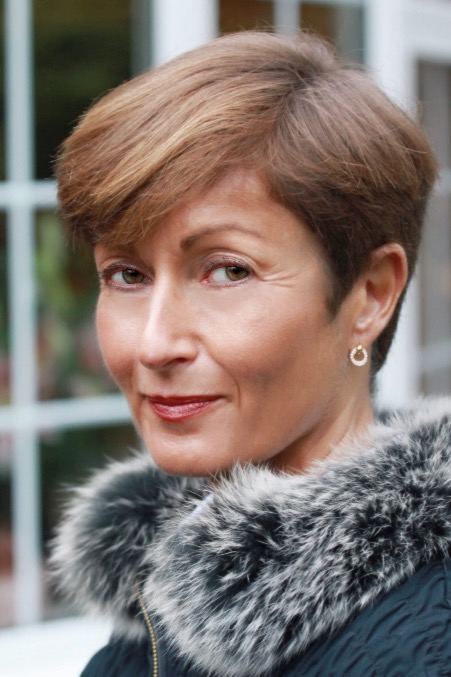
Publication Day Q&A with Deborah Stone: Pivoting from psychological thrillers to PI crime
Author Q&A
Deborah, welcome. Buried in Silence is your fifth novel – but your first ‘crime’ novel, after four psychological thrillers. For anyone new to it, can you give us a spoiler-free sense of what it's about?
Deborah Stone: Former Scotland Yard detective Ember Lockhart is hired to investigate Calvin Cross’s sudden death on a flight into Heathrow. A corrupted USB stick leads her towards a powerful technology company linked to political blackmail and corporate espionage. Threats soon follow. Then Ember’s client, Calvin’s widow, is murdered. The evidence points directly to Ember, and now she is both the investigator and the accused. Her only ally is Leo Campbell, the former colleague and ex-lover she has so often pushed away.Ember can only clear her name only by exposing people who have already proved they can and will kill without consequence
Following on from that: what made you want to swap psychological suspense for a PI crime novel – and what did you find you had to unlearn (or learn) in writing a detective story?
DS: My younger son is a huge fan of crime books and suggested that I try my hand at writing one, plus I love Slow Horses, so I thought I would see if I could write in this genre. So I tried it for James and myself too, and it’s been a thrill.
What first sparked Buried in Silence – an image, a headline, a 'what if', a character – and how much did that original idea change as you wrote?
DS: I had an idea of a man running for his life and believing that once he was on a plane and flying away, he would be safe. The whole novel stemmed from that one idea, which came to me in the middle of the night.
The book opens with Calvin Cross dying on a flight into Heathrow, and from there Ember Lockhart finds herself investigating what starts out as corporate espionage and escalates into something much bigger? What drew you to that world – and how was it a tough one to research?
DS: I wanted to write a crime novel that had some scope to involve many of the current issues concerning all of us – corrupt politicians hungry for power, the increasing ability to use tech for ill purposes, and moves away from democracy. It was hard to research, but I learnt a huge amount and had to stop myself disappearing down quite a few rabbit holes!
Ember is ex-Scotland Yard – and at points she's not just investigating but under suspicion herself. What do you enjoy about writing a detective with the walls closing in?
DS: Obviously, it adds to tension within a crime thriller, but given that I have written predominantly psychological fiction prior to Buried In Silence, I am drawn to people who find themselves in difficult, stressful situations that force them to examine not only their current dilemmas, but also their past and present traumas. Human dynamics cut across every scenario and I find it fascinating.
When you're designing a crime puzzle, what comes first for you – the method, the motive, or the emotional journey of the detective?
DS: First came the initial situation, but then it was very much about the emotional journey of the detective and her colleagues; how they interact, the mistakes they make and how they grow personally as well as professionally.
If you could ask Ember one question – and she had to answer honestly – what would you ask?
DS: Why do you find it so hard to show any kind of weakness? Is it because you think you might fall apart if your carapace cracked even slightly?
Having previous self-published your fiction, Buried in Silence is your first outing with a publisher. What surprised you most about the traditional publishing experience – and what was the toughest challenge in getting this book over the line?
DS: It is enormously exciting to be working with Vinci and to gain from their enormous expertise and ability to give my books a far greater platform than I can achieve as a self-published author, but relinquishing control and mastering my impatience is a challenge for me! Patience is not my greatest virtue!
Do you tend to plan your novels in detail (plotter), or discover the story as you go (pantser) – or something in between?
DS: Definitely more of a pantser, but I am now working on the sequel to Buried In Silence, where I am better prepared plotwise than usual, because it needs to work as a series.
What (or who) first inspired you to start writing? And have your influences shifted over time?
DS: I have devoured books since I was a small child and have written stuff since childhood as well, albeit only poems, limericks and short stories when I was a girl. I always wanted to write novels, but I needed to earn a salary, so worked most of my life as a strategy consultant as well as bringing up my two sons. When the younger one went to university, I finally had the time to write my first book and I loved it, so have carried on ever since.
And for readers who fall for Ember, will we be seeing more of her? And can you say anything about what's next, without spoilers?
DS: Yes definitely. It’s very early days but she has more cases to crack and personal hurdles to jump.
What's your desert-island read – the one book you'd take if you were stranded forever, if you could only take one?
DS: I think this is an impossible question, as I have so many books that I adore. I have thought long and hard but my shortlist is too long!
What's one piece of writing advice you find yourself coming back to?
DS: I have a postcard in front of me when I write and it says:
This is awesome.
This is tricky.
This is shit.
I am shit.
This might be okay.
This is awesome.
It makes me persevere.
Most important question: what's your favourite writing snack?
DS: A square of very dark Lindt chocolate – or maybe two.
If you can't wait to read Buried in Silence when it comes out on 14 October 2026, here's a sneaky peek:
With an hour left to run, the lights in the plane flickered back on and everyone stirred, drowsy and dehydrated. There was the usual queue for the toilets prior to landing and the normal chaos of people retrieving their bags from the overhead lockers and then attempting to stuff them all back in again prior to landing. That last hour seemed interminable. Calvin was so close and yet, he did not yet feel safe. A hard knot squatted in his chest like indigestion. The plane’s engines clunked and clanked as they inched downwards towards Heathrow, air brakes on, bumping through the angry clouds which fought against them as they tried to get through. And when they finally emerged through the dense mass, it was inevitably pouring with rain and dark as night, even though it was eight in the morning in London. Eventually, the plane thumped onto the tarmac with a definitive thud and Calvin finally felt his body relax. He unclenched his fists, unaware that he had had them in a tight ball for so long, and he wiped the sweat off his palms onto his trousers. His fingers ached. His lungs expanded, taking in the remains of the stale air on board.
‘Welcome home,’ Calvin whispered to himself.
Ladies and gentlemen, welcome to London Heathrow, where the time is two minutes past eight. You may now make and receive calls. Please remain in your seat with your seatbelt securely fastened until the aircraft has reached a complete stop. Thank you for choosing to fly Stratus Airlines and we look forward to welcoming you on board again very soon.
A few rows ahead, he heard the businessman unbuckling their seatbelts despite just being told to stay strapped in, ready for the thirty second head start that their much more expensive tickets would afford them at passport control. All around, people packed their laptops and headphones and checked carefully under their seats. A baby, who had been wailing a few rows behind Calvin for the entire flight, suddenly stopped, echoing the cessation of the siren that had been blaring in his brain for his entire journey. Phones were switched back on, text messages pinged through, calls were taken.
Calvin reached into his shirt pocket and retrieved his phone, switching off airplane mode and waiting for it to reconnect to the world. He would text Amelia and let her know he had landed. He would hopefully be home within an hour or so, Underground permitting. Despite the fact he travelled constantly, she never ceased to worry when he was in the air, despite the fact that he constantly reassured her that it was the safest form of travel.
Landed. See you shortly x
He sent the text and relaxed into his seat, closing his eyes for the first time as the plane continued to taxi to its stand.
He was roused by a text coming through on his phone, probably Amelia replying. He touched the screen.
Parting is such sweet sorrow.
About the Author
Deborah Stone is the best-selling author of four gripping psychological thrillers. Her novels have won multiple awards and critical acclaim, establishing her as a standout voice in contemporary psychological suspense and thriller fiction. She is published with Vinci Books.
In addition to fiction, Deborah is the author of the highly respected non-fiction guide, The Essential Family Guide to Caring for Older People, a finalist in the Wishing Shelf Book Awards 2022.
A recognised expert on elder care, Deborah frequently appears on BBC, ITV, Sky, and Channel 5, offering expert advice on aging, care planning, and family support. She contributes regularly to national newspapers and lifestyle magazines, helping families navigate the complexities of caring for older relatives.
She has spent most of her career prior to writing as a strategy consultant.
Deborah lives in London with her husband and their delightfully mischievous golden retriever. She has two sons.
Subscribe to my newsletter to stay up to date!
Join my cozy community of 500+ authors & publishers.