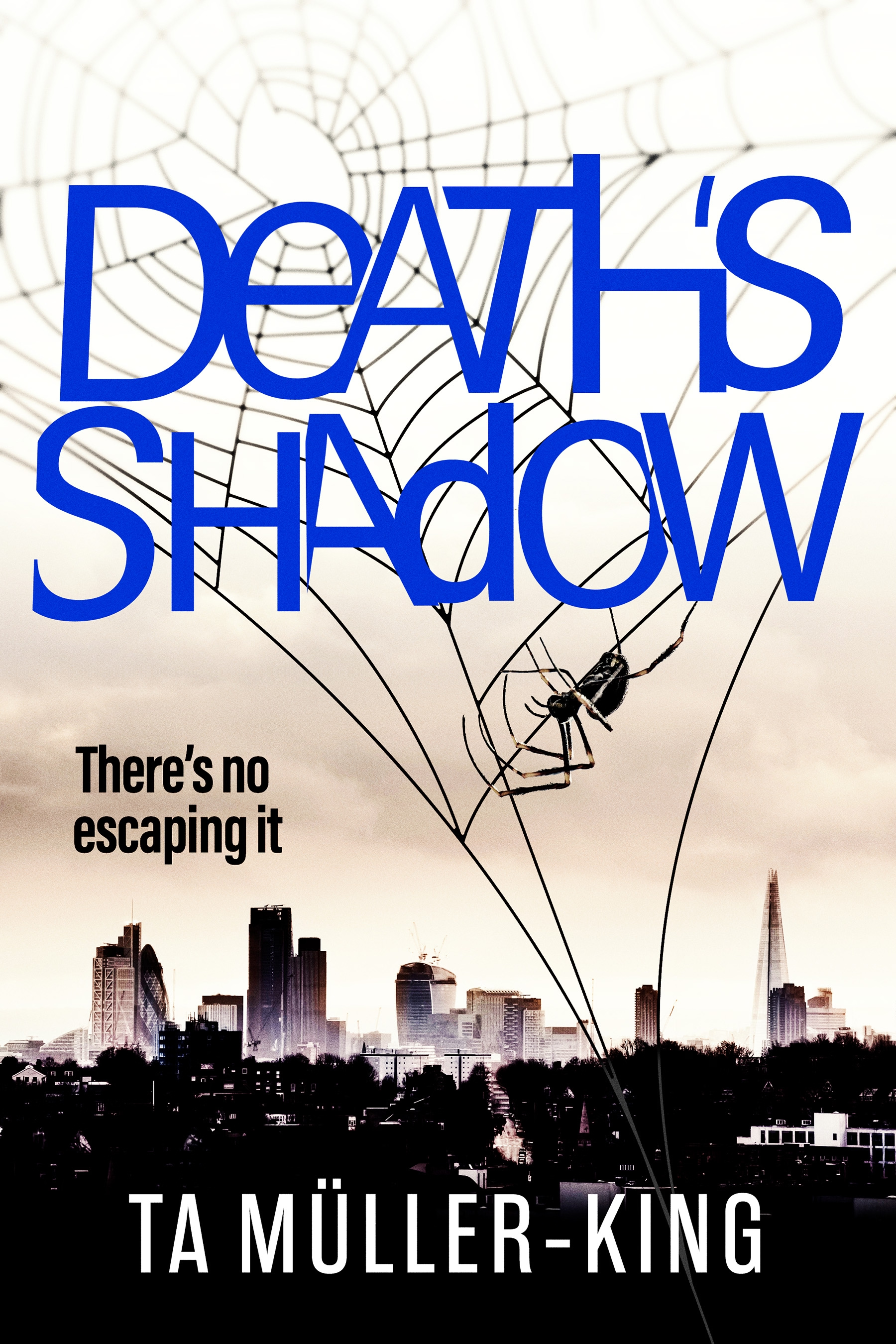
Publication Day Q&A with TA Müller-King: Writing motive, memory, and moral grey areas in DEATH'S SHADOW
Author Q&A
Tracy, welcome. Death’s Shadow is your debut novel – for anyone new to it, can you give us a spoiler-free sense of what it’s about?
TMK: It’s summer in London, and the heat is rising along with the death count as a killer stalks the streets, leaving no incriminating evidence at the scenes. If it wasn’t for the cards left with each victim, there would be nothing to connect the targets. The case is not in a good place, and the Major Investigations Team is struggling. But not as much as DCI Parker, whose memories – dark ones he’d rather forget – are being raked up by the murders. Why does it feel so personal? Does it connect to him somehow? And most importantly, if it does, can he still get the job done?
What first sparked Death’s Shadow – an image, a headline, a “what if”, a character – and how much did that original idea change as you wrote?
TMK: It was a few years back and all the news I saw seemed to show yet another country where laws pertaining to women’s rights were regressing. It sparked the glimmer of an idea, which was more dystopian in feel but then morphed into Death’s Shadow that, although inspired by the topic, doesn’t directly relate to it.
You’ve said you wanted to merge fiction with real issues – entertainment that also makes you think. What issues felt most important to thread into Death’s Shadow, and why?
TMK: Book one’s inspiration was sparked by society’s narrative that presents violence against girls and women as a female problem, one where women are held accountable and told to change their behaviour. But they are not the perpetrators, they are the victims. There have been too many cases where UK women were targeted doing nothing more than going about their lives, while I come from a country that has the highest femicide in the world – five to six times the average. These ideas are not the focus of the novel, but it raises the issues as a sub-plot, which hopefully highlights this topic in a way that is both thought-provoking and entertaining.
London is one of the most surveilled cities in the world, and your killer evades CCTV and leaves no DNA. How did you approach plausibility without turning the novel into a forensics manual?
TMK: I have a plethora of forensic books and have done crime-writing courses that cover those aspects too, but I think as clever and as advanced as we are, humans still make mistakes. The team making up the Major Investigation Team get things wrong, and sometimes technology, like CCTV cameras, don’t work. I think that’s more true to life and makes for more enjoyable readingWhen you’re designing a crime puzzle, what comes first for you – the method, the motive, or the emotional journey of the detective?
The motive is the driving force, but it’s intricately linked to the method. The deaths are used to convey a message.
You write from the point of view of both Grace and Spider – did you find one voice trickier than the other? And do you have any techniques for getting into their headspace?
TMK: Not really. I thought a male protagonist might be trickier, but they both came to life in my mind and then took over, dictating what they wanted to do and say, I just captured it. But if I’m struggling with a scene, lolling in a pool or a bath helps me become unstuck; water recalibrates my thoughts.
If you could ask Spider or Grace one question – and they had to answer honestly – what would you ask?
TMK: How do you square the circle of having a job that upholds the law when in lots of situations those rules are fallible?
As a debut, what surprised you most about getting this book over the finish line? What was the toughest challenge in writing Death’s Shadow, and how did you overcome it?
TMK: In magazines, features are written more passively with quotes, not dialogue, so creating that dynamic between characters was something new and challenging. To check if the conversations flowed and sounded natural, I read them aloud.
Do you tend to plan your novels in detail (plotter), or discover the story as you go (pantser) – or something in between?
TMK: Definitely a pantser! I sit down to write with the rough idea of the story, but the details develop as it progresses. I tend to just go with what comes up, like a new character stepping into a scene and only chapters later understanding what impact their appearance is going to have on the story. And if they end up not being relevant, they can be easily edited out in a later draft.
You write in both London and Spain – do you find your process changes depending on where you are? Do you have a routine or a favourite place to write?
TMK: The one thing constant in both places is that the writing doesn’t happen first thing – I’m not a morning person! My favourite place to write is on the terrace in Spain, surrounded by sky, mountains and orange groves.
What (or who) first inspired you to start writing? And have your influences shifted over time?
TMK: Like a lot of introverts, books featured heavily in my life from a very young age, taking me on all sorts of adventures without having to leave my home. It seemed magical to me that a book can touch and transport you like that, and I wanted to be able to do the same for other people. Plus, I love puzzles, which is where the crime writing comes in, a genre that hooked me from a young age with Nancy Drew and Agatha Christie to Ed McBain, my first police procedural.
If someone finishes Death’s Shadow and wants more with a similar vibe, what three crime novels would you recommend?
And if they say, “No – we want more Parker and Regan,” we’ve got good news: Book Two, Deathly Consequence, is out in November. What can readers expect next – without spoilers?
TMK: Set six months after Death’s Shadow, Deathly Consequence has a deranged murderer brutally killing retired pillars of the community. Their bodies are elaborately staged, with their personal belongings left carefully wrapped in protective packaging. The team must figure out the message the killer is trying to send if they are to end his rampage, but staying focused is proving to be challenging for DS Regan. Not only because the victims remind her of her father, who is about to turn 70, but because she is hiding things from her colleagues. And if she doesn’t face up to her demons, she risks not only the case but losing herself by descending permanently into darkness.
What’s your desert-island read – the one book you’d take if you were stranded on a desert island forever, if you could only take one?
TMK: To Kill a Mockingbird. There are so many life lessons in it: from being empathetic to all people, to not conforming to expected roles, and believing that people have good in them even when everything seems to point to the opposite. Important lessons in today’s times.
What’s one piece of writing advice you find yourself coming back to?
TMK: Active not passive. Not writing as if I’m reporting an event.
Most important question: what’s your favourite writing snack?
TMK: Chocolate. Doesn’t matter if it’s dark and luxurious, a Twirl or an Aero, I’ll take it.
If you can't wait to read Death's Shadow when it comes out on 3 March 2026, here's a sneaky peek:
In the time they’d been inside, the temperature had risen a little more, and Spider, still in his protective suit was, as predicted, feeling a bit like a chicken cooked in one of those roasting bags. He peeled it off, feeling the relief of the air on his damp skin and the way his temperature dropped, even though the warm air offered little in the way of coolness.
He was thirsty. As quickly as he could, he stuffed the disposable suit, shoes covers and gloves into the paper bag, sealing it before handing it to a forensic investigator who would pass it on for incineration, and headed to the car for that water he’d offered Regan. The ice had long since melted but it had done its job and the liquid was refreshingly cold. He drank until there was movement in his peripheral vision; the paramedics were finished with the witness.
Feeling a little more human now that he was hydrated and his temperature a bit more normal, he was ready to chat to the homeless man, who had moved to the wall in the shade of the tree. While the leafy branches did offer a minuscule respite from the heat, it was certainly not enough to warrant the big coat the man wore over a red jumper. Spider was getting hot again just looking at his layers of clothing.
He stood as Spider approached, a real mountain of a man who was not dissimilar to the image Spider saw in his own mirror – they were about the same height but, where Spider carried very little excess weight, the man was large under the coat; an anomaly for a homeless person, but perhaps he was not long on the streets. His hair was the same deep black, but he wore his long, and where Spider’s facial hair was neatly clipped, his beard and moustache were shaggy.
‘Morning, I’m DCI Parker. Are you alright to chat for a few moments?’ Spider’s gaze swept over him, looking for any speck of blood, but it was an unproductive search.
He nodded. ‘I don’t think I’ll be much help, though.’
His accent caught Spider by surprise, although he tried to hide it. So much for being above unconscious bias; here was the proof, smacking him in the face. Because what he had been expecting was not to hear the same cut-glass accent as his own. Clearing his throat gave Spider a few moments to think. Going back to his original train of thought, Spider said, ‘There might be something you saw or heard that might help–’
‘I didn’t see anything other than the body.’
So, he was dealing with a cool customer. Ironic considering all those damn clothing layers. ‘Okay,’ said Spider, ‘let’s start with your name.’
Death's Shadow - Out 6 March 2026
About the Author
TA Müller-King grew up in Cape Town and moved to London, where she finished her degree, and later did a post-grad. Magazines were the goal, and she interned on several, fetching more coffees than writing, until she started sub-editing women’s magazines. But food, like reading, is a passion, so it was a natural progression to move to food mags, where she started thinking about doing an MA in Crime Writing. She needed the opening chapters of a novel for submission, so she did a course (one of many over the years, from Jericho Writers and Curtis Brown to Guardian Masterclasses), but realised by the end of it that she was writing the book, so just carried on. Issues and behaviours that resonate strongly with her are her best writing motivators, and DCI Spider Parker and DS Grace Regan allow her to integrate those ideas with crime – her perfect combo.