Although there has been much talk and reaction to the Atlantic article heralding a 'post-literacy' age, it's not all doom and gloom. Back in April, at the London Book Fair, Tom Weldon, CEO of Penguin Random House UK, said plainly that he doesn't believe there's a reading crisis in the UK at all. The problem, he argued, isn't that people have stopped reading — it's that the way we find readers has changed. Literary agent Jonny Geller has made similar arguments; the traditional publishing model focuses on retailers, whereas the industry of the future needs to be more reader-focused. We're consuming stories just as voraciously, but through different channels, formats, and habits. And the data is starting to prove them right.
A recent report from BookNet Canada shared some rather cheering news: Canadians are reading more than they have in years. In fact, half of Canadians read or listened to a book at least once a week in 2025, and 79% read at least one book in the past year. But here is the bit that really made me sit up: 55% of 18- to 29-year-olds read six or more books in 2025. That is higher than the 45-54 bracket (47%), the 55-64 bracket (50%), and almost level with the 30-44 cohort (54%). Only readers aged 65 and over read more heavily (58%). The youngest generation is not abandoning books. They are reading at a rate that puts the middle-aged brackets to shame.
According to the data, 18- to 29-year-olds are the most digitally-oriented readers in the survey. They are the most likely to prefer ebooks (24%) and among the most likely to prefer audiobooks (21%), yet with 52% still preferring print books. They are not rejecting print. They are consuming across every channel while still landing on paper more often than not. Reading is, dare we say it, multi-platform.
Most readers are flexible when it comes to format. Just under a quarter of readers will only read their preferred format (22%). Print readers are the most loyal – 28% say they will not read a book if they cannot find the print version. But ebook readers are the most fluid; only 16% would forgo a book if the ebook is not available. Audiobook listeners are similarly flexible at 20%. The story is not dying. It is simply travelling across formats, and most readers are happy to follow it.
The youngest cohort is not rejecting books for screens. They are rejecting the idea that a book must be a single object on a single shelf. When we were up in Strathcona over the long weekend, this young couple, having hiked to the lake, took out two hardback books to read. Dedication to the physical page there. And it is not only the younger generations embracing the multi-platform reading experience – bouncing from the physical edition to reading on their phone on their commute, then listening to the same book on a walk. Reading is, dare we say it, trendy.
Book sales in Canada rose over 4% last year, and publishing in the UK had a record-setting year in 2025 with total revenues hitting £7.4 billion. Even anecdotally, I'm seeing book clubs – and even silent-reading parties – pop up all over my city, attracting a younger audience. In Amsterdam, the NEMO Science Museum even hosted a reading rave. So not only are we reading more, we're connecting more through reading.
I find all this immensely cheering, but also strategically fascinating. If Weldon and Geller are right – and the Canadian data suggests they are – then the problem isn't a lack of readers. It's a visibility problem. Readers are discovering books through TikTok, through serialized audio, through book clubs and silent-reading parties and Instagram reels. They're bouncing between physical copies, phone apps, and audiobooks within the same title. In fiction, the biggest share of readers read mystery and crime – 21% according to a recent YouGov survey. Fist pump.
So, I'm not sure 'post-literacy' is quite right, but how we consume words is certainly changing. The Atlantic is not wrong that the form is changing — shorter chapters, episodic hooks, sentences that land harder — but that is not the same as a dying appetite. It is a hungrier one, and hunger makes us impatient. As The Peak rather brilliantly put it, with attention spans shrinking to the point where a 20-minute episode of TV feels like a serious commitment, maybe books are exactly what we need to retrain our brains. Or maybe they need to meet us halfway.
As an editor, I'm seeing the consequences on the page. We don't have time or attention for slower builds anymore. Agents have always loved a strong hook, but now they need one that can be grasped between tube stops. Inciting incidents that used to arrive at the 10-15% mark now effectively need to land in the first couple of chapters – or even pages – or you risk losing a reader to the pull of a phone notification. In order to stand out and keep a reader's attention, it's not enough for an opening to be a welcome mat; it's got to be the one-way doors at airport security. Your reader must walk through and be transported somewhere else entirely, no going back. The writer's challenge is to make the reader think, 'But why would I want to?' That is exactly what readers are craving right now. Whether it's romantasy, horror, or crime fiction, books are fundamentally about escapism. You need to get them through before they remember that email they were supposed to send.
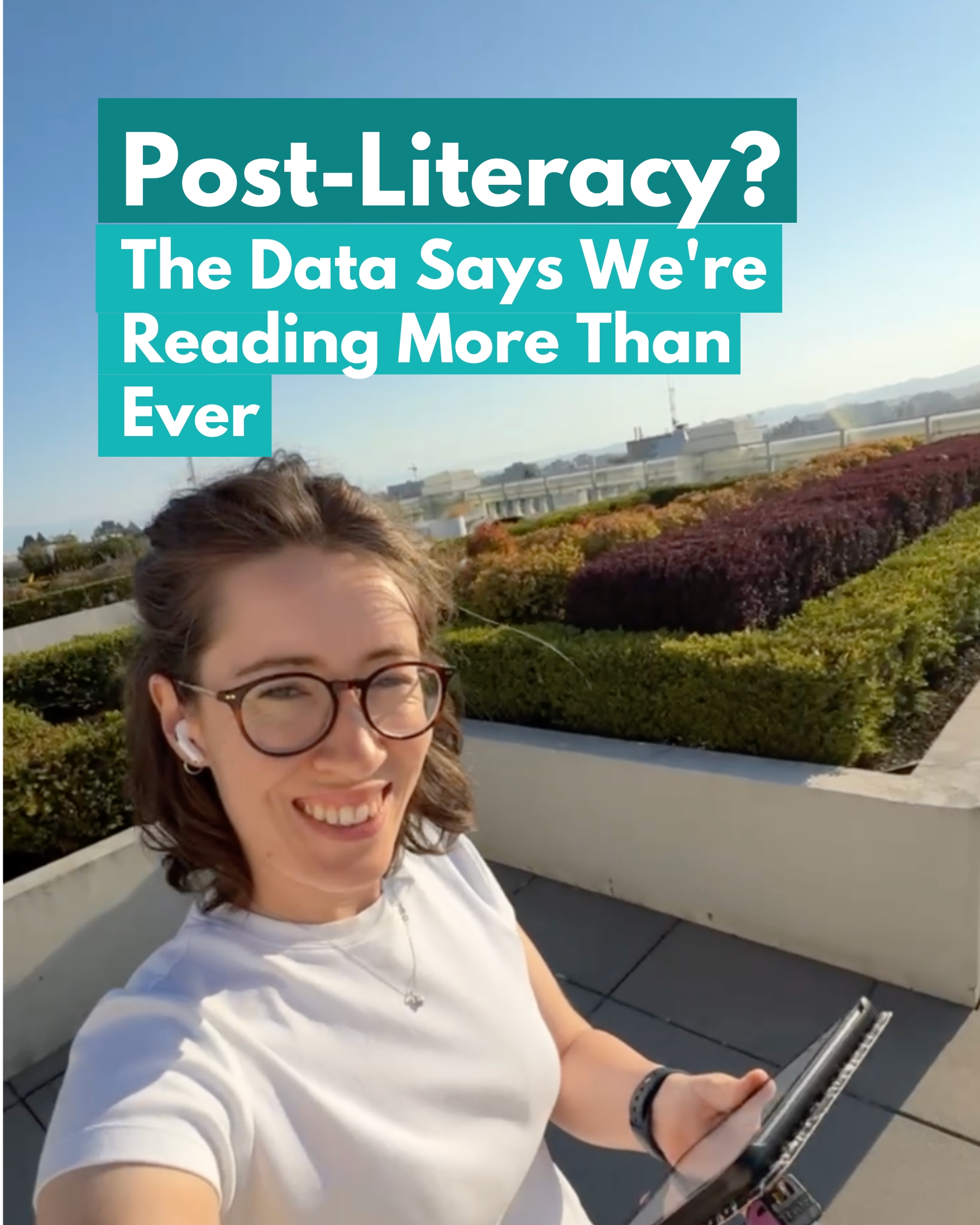
I'll hold up my hand and admit that I'm guilty of this too, and so, after a long stretch at my desk, I've started mixing things up. I take my manuscript up to the roof of my building and pace around like a racehorse in an exerciser, because I've found that a change of scenery and a bit of movement helps me focus. It turns out my brain processes a plot twist better at a trot than it does slumped in a chair. The fact that I need to physically move in circles to fully concentrate on a manuscript should tell you everything about the state of the modern attention span – and how much harder your opening has to work to pin a reader who is fighting that same urge to fidget.
For writers, this is both a liberation and a challenge. Your story is no longer merely competing with the book next to yours on the shelf. It's competing with everything – a reel, a podcast, a twenty-minute Netflix episode. But it also means the readers are out there, hungry, and finding books in ways we couldn't have imagined five years ago. The writers who thrive will be the ones who think of their story as storytelling that travels across formats, not just words on the page.
So if you're staring at your manuscript wondering whether anyone reads anymore, stop. They do. They're just finding stories differently. And isn't that exciting?
***
If you're wrestling with how to position your manuscript in this new landscape, that's exactly what the Crime Clinic is for – a strategic hour to work out where your book fits and how to get it seen.