How to Choose the 'Right' Setting for Your Crime Novel - And Why Your 'Too Local' Setting Is Your Biggest Asset
Writing Advice
A week or so ago, I jumped on one of the monthly webinars hosted by the Crime Writers of Canada, and the topic up for discussion was ‘Setting Stories in Canada’. Hosted by Eric D’Souza, the webinar tackled the all-too-familiar experience of many Canadian writers: publishers often view Canadian settings for the commercial market with caution, fearing they lack ‘exotic’ appeal or familiarity for the dominant American market. Canadian crime writer Sheena Kamal raised the same concern that same week on Instagram, where she mentioned that many writers face this problem too. However, Sheena also had some good news. In a recent call with a PR firm, she mentioned that she writes Canada. Their response? ‘That’s good, because Canada is hot right now.’ (Thank you, Heated Rivalry!) ‘This might be unusual for a Canadian genre writer [to carve a career from writing Canada],’ Sheena wrote in her caption, ‘but I think it’s changing!’
I want to dwell on that for a moment - not because this is a story about Canada specifically, but because it’s a question I often get asked: ‘Should I set my book here?’ ‘Should I use a real place or make it up?’ ‘Would this be better in the US/UK/etc?’ I suspect every writer reading this has had a version of that same quiet anxiety.
Maybe you’ve set your novel in rural Wales, or a small Yorkshire market town, or a fictional city in Scotland, or a military base in the American Midwest. And somewhere along the way, a voice - internal or external - has suggested that you might want to make it a bit more... accessible. Everyone knows New York and Washington, and with the US being by far the biggest market for fiction, it’s not foolish to think that appealing to readers in the United States is a sensible commercial strategy.
This post is my answer to that voice.
Setting is more than window dressing.
The best crime fiction I’ve worked on treats place not as a setting, but as a character. The landscape shapes the psychology.. The community shapes the crime. The social codes determine who stays silent and who talks, and why. The weather ramps up the tension just when you need it to.
Think about what we love most about Nordic Noir. Is it the procedural mechanics? No - it’s the specific, oppressive texture of place. The light. The silence. The stark snow-covered bleak landscapes that make certain crimes feel not just possible but inevitable. The setting is the story’s engine.
The same is true of the best British crime fiction - the reason why Miss Marple’s quaint village feels so sinister is precisely because it looks so idyllic. The contrast is what heightens the drama. The unsuspecting village is doing the work. (See the runaway success of Richard Osman’s Thursday Murder Club series.)
So here is my question for you: what is your place actually doing?
The types of setting that work - and why
Let me give you some concrete examples, because I think it helps to see how other writers have handled this.
The Hyper-Local Setting.
Leaning into your region’s unique flavour - its landscape, its humour, its specific social codes and rivalries - gives your book an instant atmospheric identity that no amount of ‘let’s set it in London to be safe’ strategic thinking can replicate. That familiarity allows you to almost make the location a character in itself (what I am always telling my authors to do!), meaning your narrative is all the richer for it. Plus, it makes research a damn sight easier if all you need to do is stand up from your writing desk and walk out your front door!
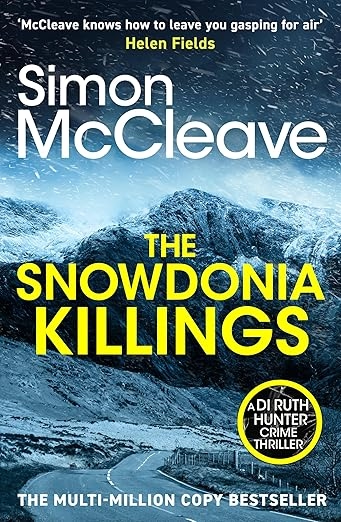
Look at Simon McCleave’s DI Ruth Hunter series - set in Snowdonia, North Wales. It has sold over two million copies. A series rooted so specifically in Welsh landscape, Welsh community, and Welsh silence that the books feel as though the mountains wrote them. It is now being adapted for television, set to be filmed on location in the very scenery that gave the books their soul. Using the specificity of the setting here allows McCleave to create an authentic world that readers can truly connect to.
The ‘I’ve Never Even Been There’ Setting
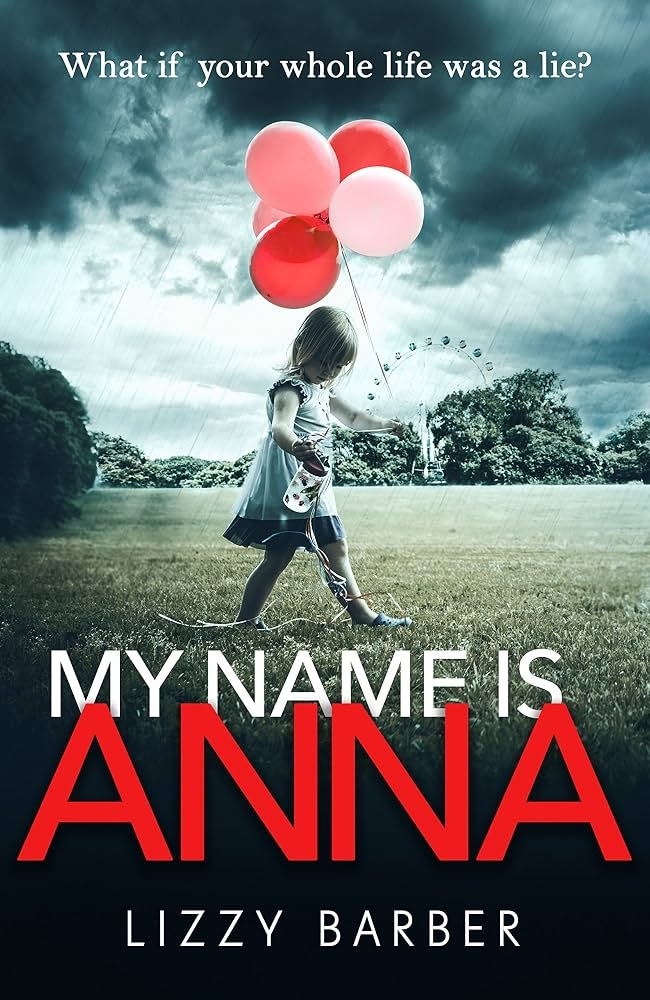
But what if you have an idea to set a book somewhere, but have never visited it yourself? Here’s one that might surprise you. Lizzy Barber wrote her debut, My Name is Anna, set almost entirely in Florida using Google Maps! Although the final location is fictionalised to a degree, her research trip was plotted on a satellite image, even taking her characters on a ‘bike ride’ with Street View. So you don’t necessarily need to have physically stood ‘on location’, but you do need to do the work to make the reader feel like they have.
The Fictional-but-Authentic Setting
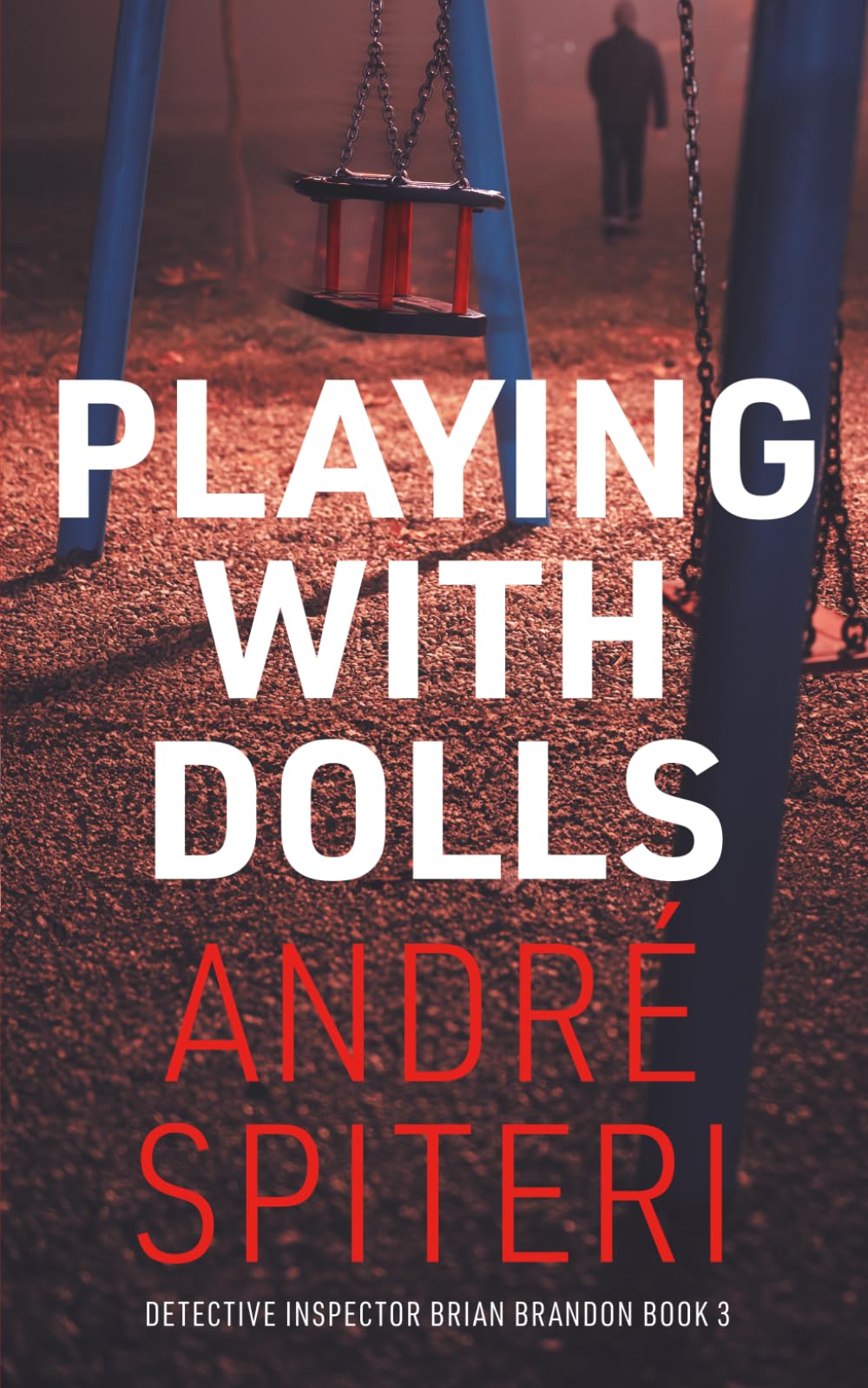
And finally, what if you have an idea for a location, but perhaps the real-life setting isn’t quite what you need? Who says you have to use a real map? My client Andre Spiteri sets his novels in the fictional Scottish city of Strathburgh, loosely inspired by real-life Edinburgh. Because he nails the feel - the texture, the light, the voice, the specific weight of Scottish national identity - the setting feels completely grounded and real, while giving him the creative freedom to invent geography that serves the plot. When you’ve no A-to-Z to refer to, it gives you the freedom to carve the story how you want, but taking inspiration from real places lends an authenticity that draws it all together and creates a place that readers can really picture (even if it doesn’t exist). There is also the added engagement of playing ‘guess the real-life location!’ when there is a sense of verisimilitude about a certain scene - and readers love that game!
The Super Specific Setting.
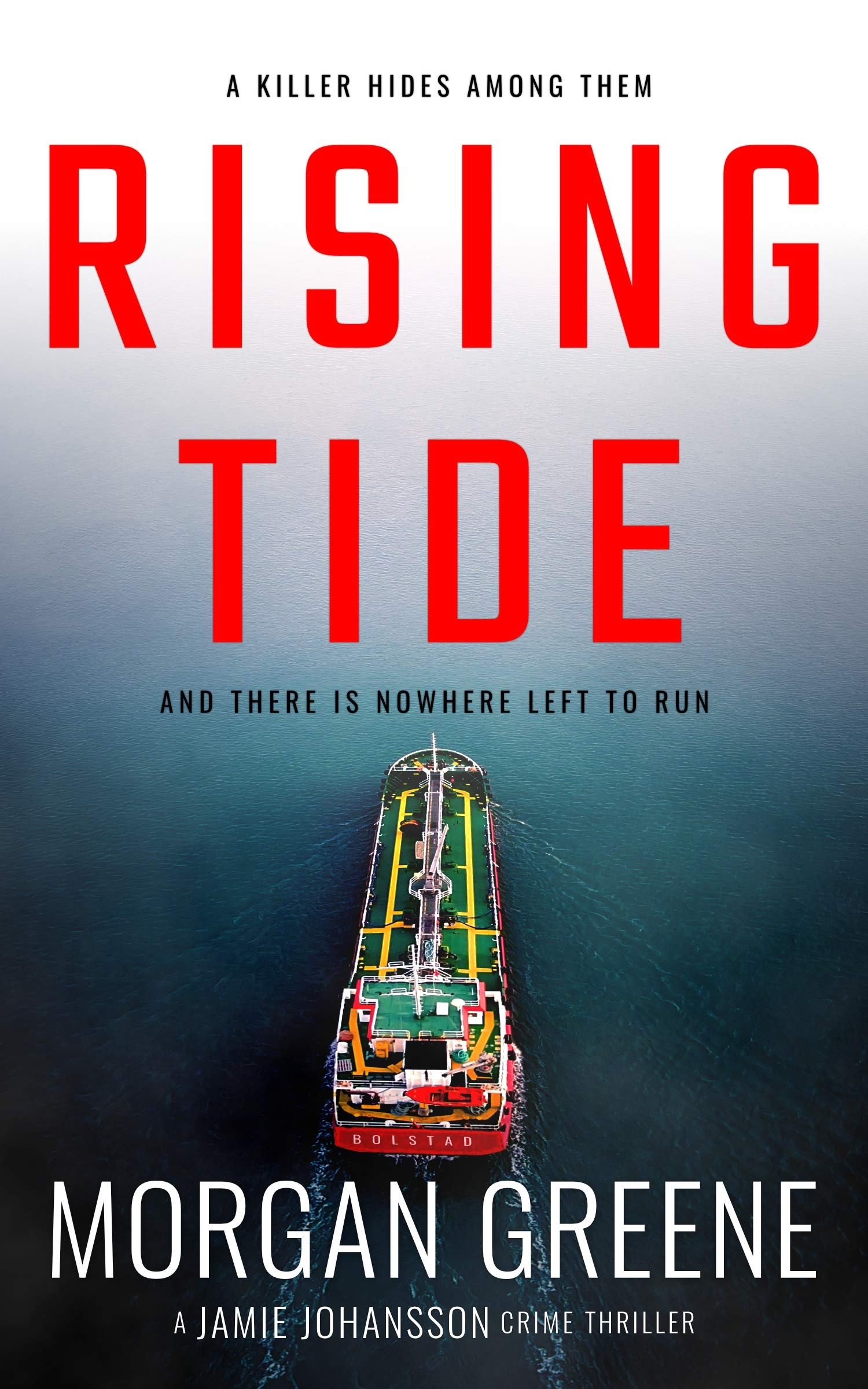
Morgan Greene's Rising Tide traps DI Jamie Johansson on the Bolstad B oil platform in the Norwegian Sea. It is a confined, industrial, unglamorous environment that most readers will never visit and few writers would think to choose. And yet it works precisely because there is nowhere to run, nowhere to hide, and the North Sea itself becomes a character. The perfect closed-circle mystery setting! And a location you won't forget.
Literary tourism
Because that’s the thing: books make us want to visit places. Especially during the somewhat turbulent times we’ve been subjected to over the years, locked down in our homes, or when rising prices mean that vacations may not be as possible as they once were. When an author has created such a vivid world in their novels, you need only travel as far as your sofa to see the world.
And often, people fall so in love with settings in their stories that they just HAVE to visit them. I mean, when we used to live in Bath, every September the streets would be lined with hundreds of people dressed up in Regency regalia for the annual Jane Austen festival. Fans from around the world visit to see the city that seems synonymous with her novels (although ironically, she didn’t actually like Bath much herself...)
Another example: on our recent trip to Quebec City earlier this month, I visited the Morrin Centre. It is a magnificent, slightly eerie building - stone walls, old books, the odd prison cell. It is also the setting for Louise Penny’s Bury Your Dead. Reader, I bought the book the moment I stepped outside. Now, although familiar with Penny’s work, I still haven’t actually read one (I know, I’m behind on my homework!), but standing in that room, I knew I needed to get on it, because I was so captured by the essence of the place.
If we take it from another angle, making sure your manuscript has a strong sense of place is a great marketing tool. Take, for example, two of my lovely authors whose crime novels are so steeped in Yorkshire, you might as well pour milk in and call them a brew! Yorkshire readers are such devoted fans that they flocked to both Murder in the Rhubarb Triangle and Blood in t’Dales events to see them. When you can name the setting of your story and pin it on a map, it means you’ve already got a ready market of readers.
Eric D’Souza told the CWC webinar that whenever he sells his hometown-set books at the local farmers market, they sell like literal hot cakes.
A practical note on using real places
Readers love it when they can connect with a book and say, ‘Hey, that book is set in my hometown’ – it gives them another reason to want to read it. Not only that, it also gives you an instant market: the bookshops there are much more likely to stock it, especially if you’re indie. Publishers much prefer specific over general because it allows you to create a much more vivid sense of place.
Of course, if your book contains a bloody murder (or some reputation-damaging event or character), use common sense. Setting it in a real city is fine, but you may want to check with any real businesses you name. Although some places might love the publicity - and stock the book!
You can have a little fun with it too. If you need to move a street for the plot, nothing is stopping you. Sometimes that restriction is a gift: it forces tension and dimension into the story.
Own it
None of this is to say there's anything wrong with London or New York - if your story genuinely belongs there, set it there. The point is: don't relocate your story out of fear. The setting should be an active choice, not a defensive one. Wherever your story is set - a blisteringly hot Australian outback, a rain-soaked Scottish island, a snowy Canadian fishing village, a Yorkshire town famous for its rhubarb - own it. The setting that feels ‘too niche’ to you is the one that will make an acquisitions editor sit up straight. Specificity is not a barrier to commercial success – it is what makes your book memorable in a crowded submissions pile. In commercial fiction, readers and editors want ‘the same but different’, and if you’ve written a cracking murder mystery, and what makes it different is the off-the-wall location, then you’re on to a winner.
***
If you’d like to talk through how setting is working (or not quite working) in your manuscript, a Crime Clinic session is exactly the right space for that. We can look at a sample, dig into the structural questions, and give you something concrete to take back to the page.
Subscribe to my newsletter to stay up to date!
Join my cozy community of 500+ authors & publishers.